


The rapid adoption of AI is driving a sharp decline in entry-level jobs, worsening the long-standing UK challenge of skills shortages. With AI now capable of performing tasks more efficiently and the employment costs ever-increasing, businesses may be questioning whether many entry-level roles remain necessary.
A major new BCC study shows that AI adoption has accelerated compared to previous years. So, the key question is – could AI replace junior staff and if so, what would this mean for the future workforce?
Skills shortages remain a persistent challenge in the UK
Many UK businesses continue to struggle to find workers with the right skills, with labour costs remaining their top cost pressure. BCC research shows that around two-thirds of UK firms report skills shortages1. A medium-sized marketing firm in the East Midlands told the BCC:
“A shortage of semi-skilled labour and engineering maintenance staff seems to be getting worse. The recent changes to employment law and taxation make it a risky proposition to take on new staff.”
The ongoing problem of skills shortages in the UK is already a serious barrier to growth. And now, with AI entering the picture and the increase in employment costs, there’s a real risk that unemployment could deepen, particularly among young people.
The impact of AI on UK businesses
AI adoption among UK SMEs is accelerating rapidly. A new study by the BCC drawing on analysis by the University of Essex shows that 54% of SMEs are now using AI tools, more than double the 25% reported in 20242, highlighting how these tools are becoming embedded in everyday business activity.
However, adoption remains uneven. Larger firms and professional services are leading the way, while smaller and consumer-facing businesses are more hesitant, often citing uncertainty or a lack of clear plans to adopt.
Firms use AI in different ways. Generic tools such as chatbots and writing assistants are used to support tasks like content creation, research, and data analysis. Only a small minority, around one in ten, have invested in more advanced, bespoke AI systems, and these firms are more likely to expect headcount reductions over the next year (figure 1).
Figure 1: Impact of AI on headcount in the past 12 months: bespoke vs generic-only AI users (Q: Over the past 12 months, has your workforce size changed as a direct result of AI?)
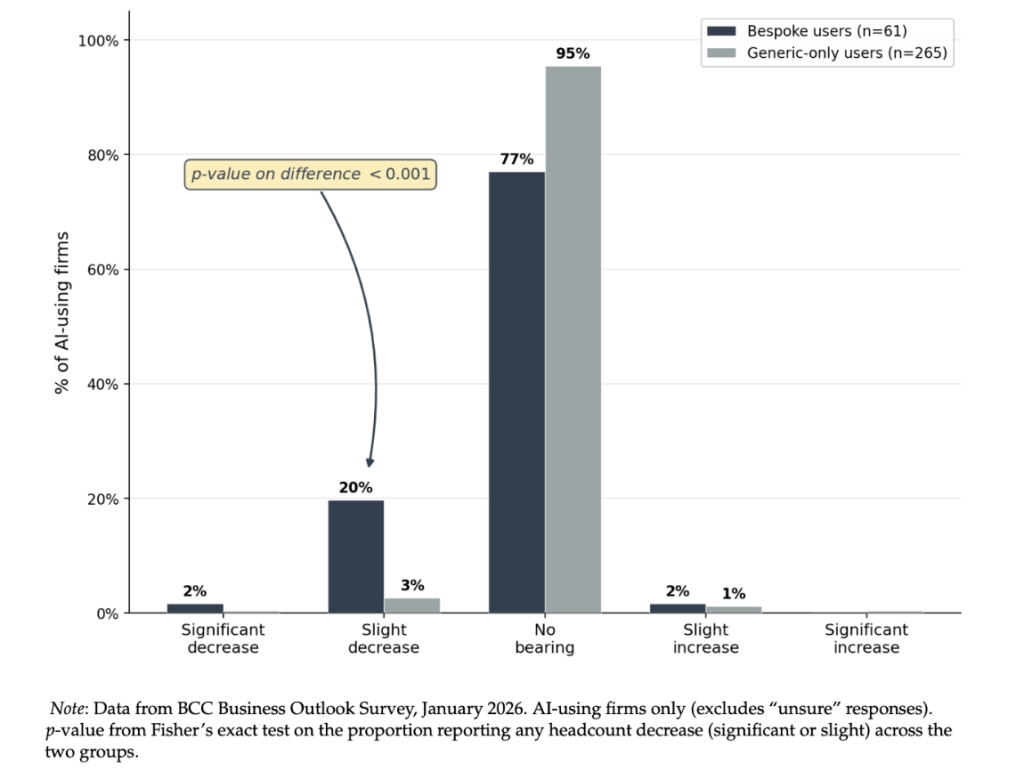
While generic tools tend to improve efficiency with minimal disruption, bespoke AI is more “transformative”, often prompting organisational restructuring, and changes to job roles. As adoption deepens, concerns are growing about the impact on entry-level jobs and the rise in unemployment.
In particular, the BCC’s latest forecast expects youth unemployment to rise to 17% this year, raising longer-term concerns about workforce participation and skills3. AI could exacerbate this trend in the long term, particularly where automation begins to replace routine tasks typically performed by early-career workers.
Balancing Costs, Technology, and Talent Development
Businesses now face a difficult balance – they must manage rising costs while also adapting to new technologies. Research by NIESR (2026) suggests that recent policy changes, such as increase in NICs and NMW and reforms to employment rights have raised the cost of hiring entry-level workers by around 7% in real terms4.
Businesses need to continue developing the next generation of workers. One approach is to redesign junior roles to combine human talent with AI. Entry-level employees could work alongside AI tools, gaining hands-on experience with new technologies while developing essential workplace skills.
The recent BCC AI report recommends using funds from the Growth and Skills Levy to subsidize AI literacy, offering tax credits or grants to encourage business investment in AI and workforce training5. Integrating AI literacy across education and lifelong learning, through partnerships with businesses and local authorities, could also help prepare the workforce for the future.
How the Jobs Market May Change
Taken together, rising costs and AI adoption could fundamentally reshape the entry-level job market. Fewer entry-level opportunities mean that young people may have less chance to gain work experience and develop essential skills. This could lead to structurally higher youth unemployment and intensified skills shortages across industries.
Supporting entry level workers to develop the right skills in an AI-driven world is not just about individual career progression – it is an investment in the long-term health of the economy. In a world of rapid technological change and rising costs, developing the next generation of workers today remains essential to prevent widening skills gaps tomorrow.
1 https://www.britishchambers.org.uk/news/2026/02/apprenticeship-system-reform-must-go-further/