


A large one-off boost to GDP, but uncertainty for the labour market
By David Bharier, Deputy Director Economics & Insights at the British Chambers of Commerce
How AI will reshape the economy is highly uncertain. Published estimates of its productivity impact vary widely and can be hard to compare. A new working paper from the Anthropic Institute[1] seeks to offer a common framework for assessing the economic impacts. Using NiGEM[2], the global econometric model of the National Institute of Economic and Social Research (NIESR), we ran two of its scenarios for the UK. In the substantial scenario, UK GDP is 7.6% above forecast at the start of 2030, close to the paper’s 8.3% for the US, and 10.7% above by the end of 2031. Unemployment rises first, by up to 1.3 percentage points, though we treat the later fall below forecast with caution.
The Anthropic Institute paper
The Anthropic Institute’s paper uses a task-based growth model where AI can automate a task, assist a worker, or leave it untouched. It affects only knowledge work, which the paper calls cognitive occupations and which makes up 62% of US employment. As displaced workers search for jobs elsewhere while wages adjust slowly, unemployment rises. The model’s starting point is based on data on how AI is used today: Anthropic’s records of work use, the Census Bureau’s firm survey and field trials of productivity. Where AI gets to by 2030 is assumed. The paper outlines three possible scenarios.
- Modest: AI performs 4% of all work in the economy, at 35% higher productivity. In this scenario, US GDP is 1.6% above a no-AI path and unemployment rises by about 0.1pp.
- Substantial: AI performs 12% of all work, at 57% higher productivity. US GDP is 8.3% higher and knowledge-work employment falls by around 4%.
- Extreme: AI performs almost half of today’s knowledge work. US GDP is 32% higher, growth reaches 15% a year, and nearly one in five knowledge workers is unemployed.
Applying these scenarios to the UK
We applied the paper’s modest and substantial scenarios to the UK in NiGEM[3], as a rise in how much each worker can produce. The boost starts in 2027 and reaches its full size in 2030. The main results run to the end of 2031, and we look at the longer run to 2050 further down. We assumed the same boost happens in every country at the same time. That means the UK results also reflect its trading partners becoming more productive, and how that feeds through trade, prices and financial markets. The BCC’s September 2026 forecast, also produced using NiGEM, is used as the baseline[4].
The Anthropic paper models AI taking over tasks, and the time displaced workers take to find new jobs. By contrast, we model AI only as a rise in labour productivity. That means that our jobs results reflect how NiGEM’s labour market adjusts, not how hard it would be in practice for people who lose their jobs to AI to find other work. A productivity boost on its own also can’t show income shifting from wages to profits, or knowledge workers falling behind everyone else, which is one of the Anthropic paper’s key findings.
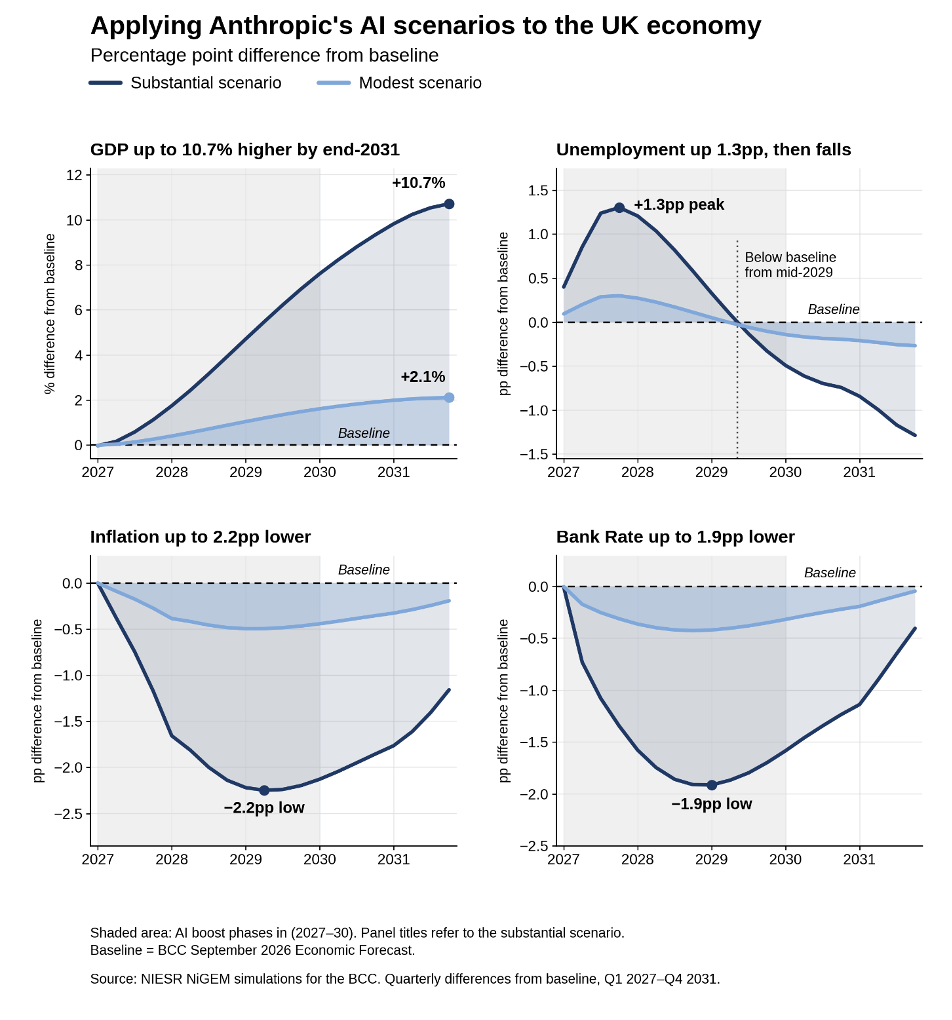
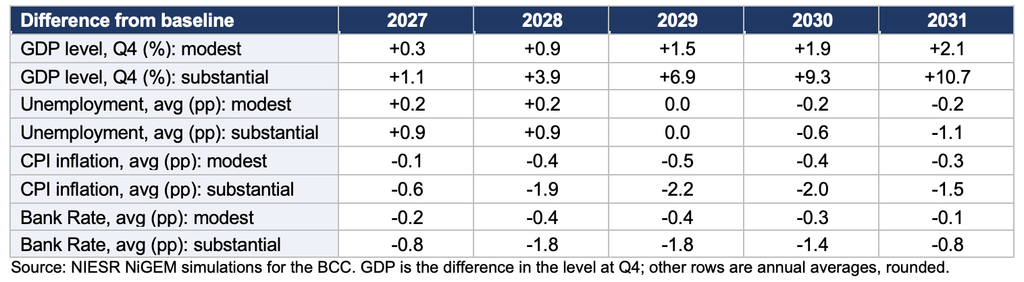
GDP. Each worker produces more, so the economy can produce more with the same workforce. By the end of 2031 GDP is 2.1% higher than forecast in the modest scenario and 10.7% higher in the substantial one. This is largely a one-off rise in the size of the economy, not a lasting rise in the growth rate.
Jobs. Output per worker rises faster than demand for goods and services, so firms need fewer workers and unemployment rises. It peaks at the end of 2027 at 0.3 points above forecast in the modest scenario and 1.3 points above in the substantial one. Slower wage growth and lower interest rates then bring hiring back, and by the end of 2031 unemployment in the substantial scenario is 4.2%, 1.3 points below forecast. This however should be treated with caution because no cost of moving between occupations is modelled. In reality, retraining and changing occupation take time.
Prices. A weak labour market is followed by weaker wage bargaining and lower inflation: up to 2.2 points below forecast in the substantial scenario, and below zero from late 2028 to mid-2030. The Bank Rate is 1.4 points below forecast in 2030. GDP is above forecast from 2027 Q2, so this is not a collapse in demand.
After 2031
Our NiGEM modelling extends to 2050, well beyond the paper’s 2030 horizon. In the substantial scenario, interest rates rise back above forecast in 2032-34 and unemployment returns above forecast by up to 0.4 points in 2035. The GDP gain slips from a peak of 10.8% to 9.0% before recovering to about 11.7% by 2050. The gain in the size of the economy lasts, but the fall in unemployment does not.
UK and US compared
At the start of 2030, UK GDP is 1.6% higher than forecast in the modest scenario and 7.6% higher in the substantial one. The paper’s US figures are 1.6% and 8.3%. The comparison is rough since the models differ – the Anthropic paper measures against a world with no AI, while the UK baseline already reflects AI use to date, based on the BCC’s AI adoption surveys.
The bigger difference is on jobs. In the paper’s substantial scenario, US unemployment is still 0.8 points above its no-AI path at the start of 2030 (4.6% against 3.8%), because displaced workers struggle to switch occupations. In our UK results it is already about 0.5 points below forecast. Our modelling doesn’t include that difficulty in switching jobs, so the UK figures probably understate the disruption for those most affected.
What decides which scenario we get
The gap between the two scenarios is mostly depth of use. In the substantial case AI does three times as much of the economy’s work. The paper itself notes that technologies have historically spread far more slowly than recent AI take-up suggests.
Headline adoption is probably the wrong gauge. BCC surveys show AI use among UK firms rising from 25% in 2024 to 54% in early 2026, but it is depth of adoption that determines the wider organisational and productivity impacts. The Anthropic paper’s diffusion parameter is the share of task instances actually done with AI, and it warns that firm-level shares overstate it.
As I outline in my chapter in the BCC’s book ‘How the UK Can Become an AI Adoption Superpower’[5], the electricity revolution shows why. In the early 20th century, factories first swapped the steam engine for one big electric motor and kept the old shafts and belts. Productivity rose only decades later, when each machine got its own motor and the floor was rebuilt around the work[6]. AI looks similar so far. In our 2026 study with the University of Essex, 45% of AI-adopting firms used generic tools alone and only 10% had built something of their own[7]. A firm that buys everyone a chatbot licence and changes nothing else has bolted a new motor onto the old shaft. Whether the UK ends up nearer the modest or the substantial scenario depends as much on whether businesses reorganise around AI as on the technology itself.
[1] Korinek, A., Jones, C.I., Sacher, S., Cotter, T. and McCrory, P. (2026), Economic Scenarios for Transformative AI, The Anthropic Institute Working Paper No. 2026-02
[2] Modelling carried out by Ed Cornforth, economist at NIESR, using NiGEM https://niesr.ac.uk/nigem-macroeconomic-model
[3] The extreme scenario was not run since it implies such a break from the past that a model built on historical relationships would give low confidence in the results.
[4] https://www.britishchambers.org.uk/news/2026/09/bcc-economic-forecast-weak-business-investment-hits-growth-outlook/
[5] Bharier, D. (2026), ‘The Constraint is Moving’, in British Chambers of Commerce and BDO, How the UK Can Become an AI Adoption Superpower.
[6] David, P.A. (1990), ‘The dynamo and the computer: An historical perspective on the modern productivity paradox’, American Economic Review, 80(2), 355–361
[7] Bharier, D., Etheridge, B. and Morais, P. (2026) AI adoption and workforce change in SMEs, ISER Working Paper Series, No.2026-01. Colchester: University of Essex