

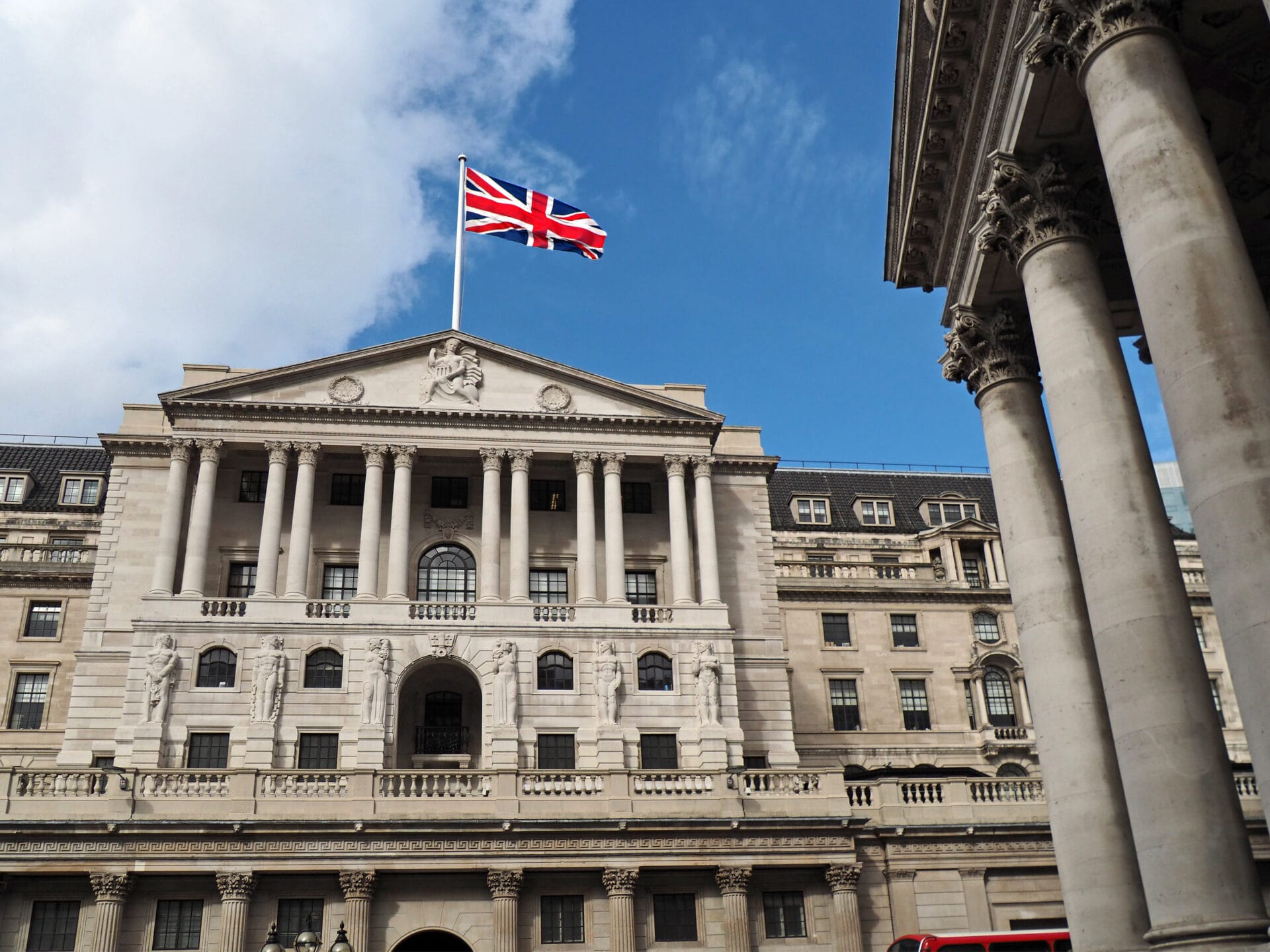
The current Middle East conflict has put the Bank of England in a uniquely difficult position. Inflation remains stubbornly above target, while the UK economy continues to struggle for momentum. The key question now for the Bank is whether the current interest rate is sufficient to address the inflation shock or whether a rise in interest rates could be the solution, despite the risk of economic damage.
Weak Growth Complicates the Inflation Fight
The dilemma is clear: cutting rates too early could allow inflationary pressures to rise again, while keeping them elevated for too long risks placing further strain on households and businesses already facing high costs.
The current situation differs from 2022, when the sharp rise in energy prices following Russia’s invasion of Ukraine, alongside post‑Covid supply chain disruption, drove a major inflation surge and forced the Bank of England into aggressive rate hikes.
Today, the UK economy is starting from a much weaker position, with slower growth, higher unemployment, and interest rates already at relatively restrictive levels compared with 2022.
The BCC’s latest forecast expects the UK economy to grow by just 0.9% this year, reflecting the impact of the conflict in Iran and higher energy costs[1]. Unemployment is expected to peak at 5.2% this year, while inflation is expected to rise to 3.8% by the end of 2026. We then expect the Bank to hold rates at 3.75% throughout the rest of 2026, given that monetary policy is already relatively tight.
This broadly aligns with the International Monetary Fund (IMF), which has argued that keeping rates on hold could help bring inflation back under control[2]. The IMF’s view is that keeping interest rates on hold would maintain a sufficiently restrictive monetary stance to limit “second-round effects” and keep long-term inflation expectations anchored.
What are second-round effects, and will they happen again?
In assessing the future path of interest rates, the IMF looks closely at whether inflation is becoming more persistent across the wider economy. This includes monitoring so-called “second-round effects”, where higher energy and input costs begin feeding into wages and broader business pricing, creating a cycle of longer-lasting inflation.
Businesses facing higher costs may raise prices, while workers may push for higher pay to keep up with living costs, creating a cycle that keeps inflation elevated for longer. The IMF has argued that interest rates should remain sufficiently restrictive to prevent these pressures from becoming embedded.
So, could second-round effects emerge again?
The risk cannot be ruled out, particularly if tensions in the Middle East continue to push up global energy prices. However, the current economic backdrop differs from 2022.
Second‑round effects are more likely when businesses feel able to keep raising prices and workers are in a strong enough position to negotiate higher wages. At the moment, weaker demand and a softer labour market may limit both of these pressures, reducing the risk of inflation becoming more deeply embedded across the economy.
Against this backdrop, a pause in interest rate changes could prove the most balanced approach for the Bank of England, provided inflation expectations remain stable and inflation doesn’t spike over the longer term. The trajectory of the conflict in the Middle East and energy prices, will remain key factors for the Bank to monitor.
Monetary policy alone may not be enough
Today’s economic environment is being shaped by geopolitical instability, higher energy costs, weak growth, and ongoing uncertainty around global trade. As businesses begin to adjust to one shock, another quickly emerges, making long‑term planning, investment, and hiring difficult.
Alongside higher energy prices, businesses are now facing rising domestic costs linked to higher labour costs, increases in employer NICs and ongoing trade frictions.
In this context, interest rates alone may not be enough to restore stability. While monetary policy can help slow inflation by weakening demand, higher rates could put additional costs pressures for households and businesses.
The Bank of England has highlighted that higher interest rates increase mortgage and loan repayments, leaving consumers with less money to spend, while more expensive borrowing discourages consumers and businesses to invest[3].
Growth will therefore depend not only on monetary policy, but also on policy coordination. Businesses continue to highlight the need for lower labour costs and taxation, improvements to UK–EU trading arrangements, and a clearer long‑term economic strategy to support investment and productivity.
The challenge for the Bank of England is no longer simply controlling inflation but doing so without causing further damage to growth. A more stable and resilient economy will also require coordinated government action to reduce business costs, improve certainty, ease trade barriers, and support long‑term investment and productivity.
Further reading:
[1] https://www.britishchambers.org.uk/news/2026/06/bcc-economic-forecast-growth-to-remain-subdued-as-business-investment-is-hit/
[2] https://www.imf.org/en/news/articles/2026/05/18/pr26154-united-kingdom-staff-concluding-statement-of-the-2026-article-iv-mission
[3] https://www.bankofengland.co.uk/monetary-policy/the-interest-rate-bank-rate