


With Alan Milburn set to publish his keenly awaited review of Young People and Work this Autumn, it’s vital we build a complete ladder of opportunity for young people, not just the first rung.
To support strong, lifelong career pathways, businesses need to see three things:
- Better careers, employability and work experience opportunities in schools
- An all-age, all-stage apprenticeship system
- A stronger Lifelong Learning Entitlement
Helping young people climb the career ladder
The UK needs to develop a culture of lifelong learning; work is changing and working lives are getting longer. A recent report by the British Chambers of Commerce identified that improving UK productivity needs adults to upskill and reskill throughout their careers.
But this culture is not built overnight, nor can it be implemented by a top-down policy intervention. People need to develop a ‘learn how to learn’ mindset, and careers’ education must be a much stronger focus in school.
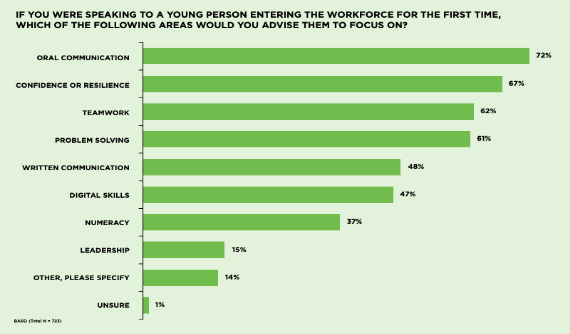
BCC research shows firms want young people to focus on transferable skills alongside literacy and numeracy. Schools should be embedding these skills across the curriculum and, importantly, teaching students how to articulate them. Businesses can upskill people with the technical training they need, but candidates need to come to the door with the ability to adapt, resilience and the confidence to try something new.
For the million young people not in education, employment or training (NEET), the idea of a career may feel all too distant. It can be difficult to gain momentum when you are struggling to get your first foot on the ladder, and you cannot see opportunities in your community. The challenge is to make those pathways visible.
Bringing careers to life
The Careers and Enterprise Company estimates that current careers advice and guidance is delivering £300m a year in net fiscal benefit from NEET reduction alone. If the Government wants an intervention to scale which delivers value, has low up-front investment and builds employer partnerships with education, this is where they should look.
Good careers activity connects what students are learning in the classroom to the opportunities around them, now and in the future. Rather than just focusing on the first rung, students should be shown what the whole ladder could look like for them.
Employer-led Local Skills Improvement Plans (LSIPs) can be a vital piece of the puzzle. They provide granular insight about the range of careers available in a local economy and connect schools with businesses looking to build their talent pipelines. LSIPs originally set out to impact FE provision, but Chambers of Commerce, which lead many of the plans, have identified schools as an option to go further. There is a huge opportunity to shape learner demand and ambition from an earlier age.
The Young Chamber programme led by West Cheshire and North Wales Chamber of Commerce is doing just that. It includes industry-specific workshops, a locally recognised career passport to develop and evidence essential employment skills, and a 12-week enterprise challenge. These elements help students build confidence, understand workplace expectations, and develop skills valued by employers.
The convening power of the Chamber also means employers are getting involved who may have never engaged with schools before. Across 2023/24, businesses contributed 226 hours of engagement benefitting 3,128 pupils through industry-led workshops, mock interviews, mentoring and workplace visits. And as Young Chamber is delivered by a third-party, neither state nor education provider, the programme has the agility to pivot to where it can add the most value, responding rapidly to changing employer needs.
Apprenticeships to drive growth and progression
Apprenticeships are high-quality qualifications valued by employers for training learners on the job. Apprentices get hands on practice and employers get a trained employee with loyalty to the business and work readiness as soon as they are qualified. Apprenticeships offer a strong pathway to progression from Level Two all the way to Level Seven. Having this clear pathway makes apprenticeships a more attractive route for learners and their influencers, like parents.
It’s important that employers have access to higher level apprenticeships to upskill more experienced employees. Higher level skills drive productivity and growth, and as people move up the career ladder, it opens vacancies below.
Ultimately, creating more opportunities for young people can only come from driving growth in the economy. That means continuing with a Growth and Skills Levy fund that can be spent on apprenticeships at all ages and stages.
Unlocking potential of the Lifelong Learning Entitlement
Businesses have consistently called for a more flexible, modular lifelong learning offer to support in-work upskilling. The Lifelong Learning Entitlement (LLE) has the potential to become a significant pillar of lifelong learning in England. From January 2027, eligible learners will be able to access student finance for full courses and some modules at Levels Four to Six, with a tuition loan entitlement equivalent to four years of post-18 study. This may be an attractive route to many young people juggling caring responsibilities or health conditions.
However, there is a risk that the reality of the LLE does not yet match the scale of the original policy ambition. Awareness of the model remains limited, and the range of modules available at launch appears narrower than many employers expected.
The current model would be strengthened by a clearer framework for employer co-investment. Employers are willing to invest in training where it supports workforce development, retention or future skills needs. However, firms need a simple and credible mechanism for doing so, alongside individual finance and public funding. Without that framework, there is a risk that the LLE is treated primarily as an individual loan product, rather than as part of a wider system.
Building the whole ladder
The Milburn review is a chance to turn ambition into action. It must bring careers and employability to life in every school, protect apprenticeships for all ages and stages, and strengthen the Lifelong Learning Entitlement. If it succeeds in this, then employers will have confidence to invest, alongside individuals and government. Young people need more than a first rung; they need a clear route to climb, retrain and progress throughout their working lives.
Read more – From Classroom to Career: Delivering Growth through Lifelong Learning