

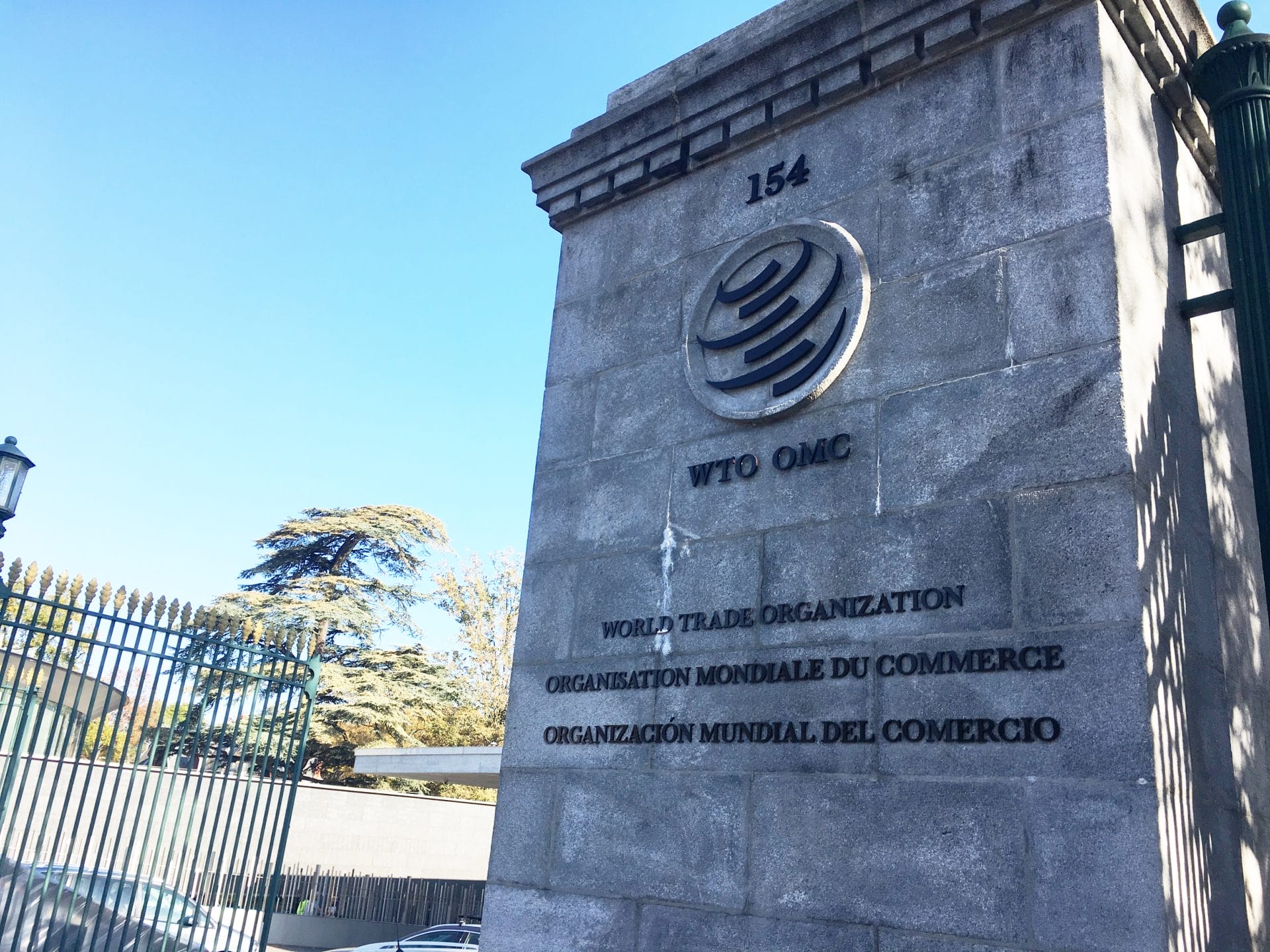
Last week in Geneva, more than 4,000 delegates from governments, business and civil society met at the World Trade Organisation (WTO) Public Forum to debate the future of the rules-based trading system.
Issues up for discussion included the impact of a tumultuous year of global trade policy and how to progress an inclusive approach to the rising trade in services across the world.
For the first time the role of AI in global trade was also a key topic. WTO data showed that while global goods trade rose by 3.2% year on year (Q1 2025 to Q1 2026), trade in AI-connected products rose 42%.
Other key topics were:
- Subsidies as an industrial and economic policy tool
- Economic security and treatment of critical minerals by developed and developing nations
- How the benefits of enhanced global trade in services need to be more widely distributed across the world
- Whether the Most Favoured Nation (MFN) principle – that all countries should be treated on the same basis in tariffs by other states – should continue to sit at the heart of global trading rules.
The BCC also met with Director-General Dr Ngozi Okonjo-Iweala at WTO headquarters and took part in a Centre for Inclusive Trade Policy roundtable on MFN with Chief Economist Bob Staiger.
The WTO World Trade Report
This year’s report looked at the key question posed by businesses over the past 18 months as tariffs, protectionism and unilateral action by the US and China has proliferated:
How does the World Trade Organisation system remain relevant in a world riven by geopolitical fragmentation?
The report breaks this down into three distinct arguments:
- It points to the benefits of WTO membership for trading nations since its formation in 1995 – a 140% increase in trade among the 166 WTO members, since then.
- Its relevance today – with 72% of global goods trade being conducted under WTO rules. This is down from 80%, two years ago, but still a sizeable proportion.
- By examining what could be. It has modelled future growth in the global economy and exports, comparing three scenarios:
-
-
- Reforms to the WTO are made alongside further multi or plurilateral agreements
-
-
-
- No WTO reforms and further geo-fragmentation
-
-
-
- The collapse of the current system and a reversion to just free trade agreements.
-
It found that WTO reform could lead to a 2.9% increase in global GDP and a 17% increase in exports. If further geo-fragmentation occurs, global growth could instead decline by 5.1% and exports by 18.6%. The most extreme option could shrink global GDP by 6.9% and reduce exports by 26.9%. Developing countries would lose out the most in the latter two scenarios.
But both the WTO’s Director-General, Dr Ngozi Okonjo-Iweala, and its Chief Economist, Bob Staiger, recognise reform of the organisation is necessary. WTO rules have not caught up with the changing balance of economic power.
This has seen the share of growth in the world economy for developing countries rise from 23% to 45% over the past three decades. As a result, there have been increasing tensions around level playing-field issues especially in relation to economic and national security concerns.
What is also very clear is that economic intervention in trade by individual nations has expanded rapidly in the past decade, through subsidies and export controls. This raises questions about how this trend can continue to coexist within the global rules-based order. The WTO’s argument is that the rise of geo-fragmentation makes co-operation between nations even more important.
BCC Input
The BCC attended the Centre for Inclusive Trade Policy’s roundtable on MFN. The discussion revolved around the system’s future and how economic security might be given more status in potential exceptions to key tariff and trade rules.
European preference rules, US tariff policy and China’s subsidies policies on industrial production were also considered. There was little appetite to abandon the MFN principle nor make it subject to excessive conditionality.
We were also involved in a discussion convened by the International Chambers of Commerce on EU-CPTPP (Comprehensive and Progressive Agreement for Trans-Pacific Partnership). This looked at co-operation on services, the potential benefits of freer data flows, reduced data localisation provisions and restrictions on cloud technology. These were felt to be real priorities for negotiations, which are set to conclude before the end of the year.
Other Trade Issues
Over 110 sessions were held across the three days of the Forum. There was animated debate in a session on critical minerals and whether developing states would secure additional added economic value from mineral extraction. This was addressed by the WTO’s Director-General, Dr Okonjo-Iweala, and the Democratic Republic of Congo’s Trade Minister, Julien Paluku Kahongya.
Approaches on controlling excessive and unfair usage of subsidies in production and exports featured strongly in the Peterson Institute for International Economics’ Trade Winds discussion, chaired by former EU Trade Commissioner Cecilia Malmstrom. The BCC also had an opportunity to speak with the UK Ambassador’s team at UKMIS on market access for UK firms overseas.
A key theme throughout the week was the growth in the global services economy. Countries ranging from Canada to Namibia now describe themselves as services economies, and this switch to a services-rich economic model was particularly noticeable in the Asia-Pacific, Africa and the Americas regions.
World Bank data confirms that the UK is 81% a services economy, with 83% of jobs in the economy being in services.
Why this matters for business
Fundamentally, the WTO system provides businesses with stability. They can expect to be treated the same as other countries under the tariffs and services schedules set down by the WTO.
The rules-based system also results in better trade deals for businesses through more equal bargaining power between countries rather than a beggar my neighbour approach would can lead to asymmetry and inequitable outcomes.
The big test over the two next years will be if tariffs on electronic transmission of goods and services can continue to be averted.
Sustaining growth in global trade will also rest on reform of the WTO and the output of its members in pursuing plurilateral agreements on services and subsidy controls. This has the potential to maintain a level playing field for exports and sustain growth in global trade.