


Place-based growth meets a fragile economy
Andy Burnham’s recent speech in Manchester set out an ambitious economic vision of “good growth in every postcode”. He outlined a major rebalancing of power away from Whitehall, with a renewed focus on housing, transport, skills, infrastructure and industrial renewal.
For the UK Chamber of Commerce Network, much of this will feel familiar. Chambers have long argued that economic policy works best when it is shaped close to the businesses and communities it is designed to serve.
But the latest BCC Quarterly Economic Survey shows the hard economic reality facing the man who will very likely be the next UK Prime Minister. Business conditions weakened further in Q2 2026. Fewer firms reported rising sales, export sentiment weakened, confidence remained fragile, and investment intentions dropped to their lowest level since the pandemic. The survey drew on responses from 4,744 businesses, 92% of them SMEs, between 11 May and 8 June.1
These latest insights ask not whether place-based growth is desirable, but whether it can deliver quickly enough in a weak trading environment.
The importance of investment
The sharpest warning from the QES is on investment. Only 17% of firms said they planned to increase investment in plant, machinery or equipment, down from 21% in Q1. A quarter (26%) planned to cut back. That’s the lowest level since the Covid pandemic.
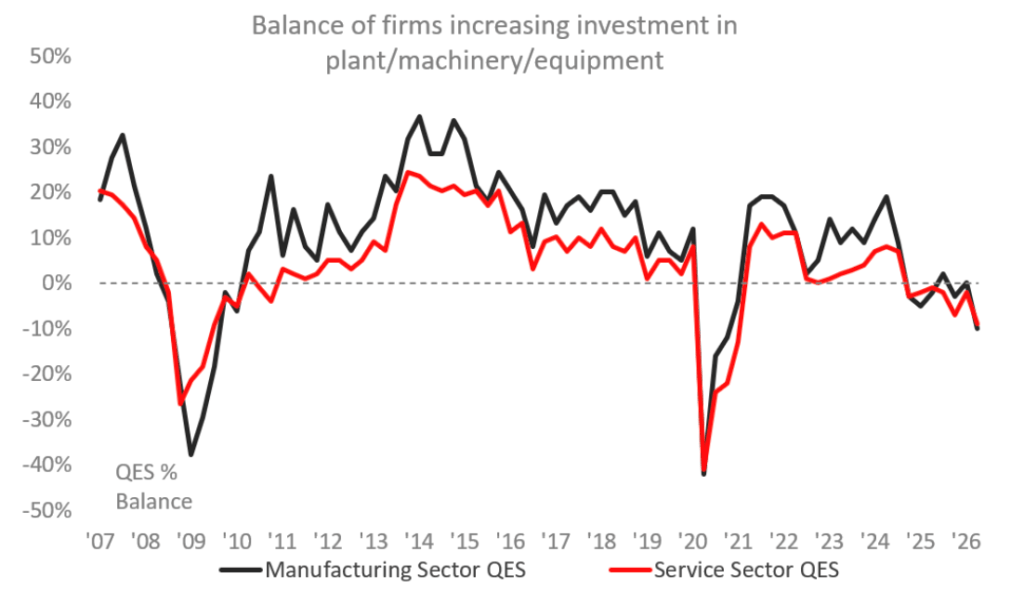
Source: BCC QES. Q: Over the past 3 months, investment plans for plant, machinery, tech, or equipment have (increased, remained constant, decreased). n=4,133.
This is where ‘Manchesterism’ has both relevance and a major test. Burnham’s model of using public and private investment to support regeneration, transport and housing fits well with the Chamber Network’s call for long-term investment in transport, digital and energy infrastructure.
But businesses will judge it by delivery. Does it make decisions faster? Does it make accountability clearer? Does it make business support easier to navigate? Or does it create new structures, overlapping responsibilities and more bureaucracy without better outcomes?
The recent BCC report2, co-authored by BCC President and former Chief Economist at the Bank of England Andy Haldane, set out a clear test to measure exactly that: before announcing any major economic measure, policymakers should ask, will this prompt firms to do something they would not otherwise have done?
Confidence slides away
The QES also shows that confidence has weakened. Just 44% of firms expected turnover to improve over the next 12 months, down from 49% in Q1, while 23% expected a decline. This is a return to turnover confidence being on a downward trend, following a brief recovery earlier in the year.
This is the backdrop against which any new Government must operate. Place-based growth can help business confidence because many firms experience the economy locally. The recent speech in Manchester highlighted local skills and procurement as two priorities for any new administration. Confidence may grow if smaller firms have a fairer chance to access major public and private-sector supply chains as well as being able to find people with the right skills, in the right places, at the right time.
Costs pressures go supersonic
The survey also shows inflation re-emerging as the leading concern for businesses, cited by 66% of firms. Fuel costs rose sharply as a price pressure, while labour costs remained the most common source of price pressure.
This is a key constraint on the devolution agenda. Businesses may support stronger local powers, but they will want reassurance that fiscal devolution does not become a route to unnecessary new local taxes or levies. In an environment where firms are already under pressure from wages, tax, utilities, fuel and borrowing costs, the margin for policy error is narrow.
Trading half the world away
Burnham’s speech went big on domestic renewal, but less clear on how firms will be helped to sell overseas, navigate global supply chains or access new markets. That will be a worry for Chambers at a time when QES export sales indicators have been declining across the board, dropping into negative territory in Q2.
A stronger local economy cannot only mean better domestic coordination. It must also mean helping firms connect to global markets. “Growth in every postcode” must also mean connecting every postcode to the world.
The masterplan
The right test for any new administration is therefore the BCC’s Growth Delivery Test: will it prompt firms to do something they would not otherwise have done?
Will more firms invest? Will more recruit and train? Will more enter supply chains? Will more export? Will more scale?
The QES suggests many firms are stuck in a risk-aversion cycle. Burnham’s agenda could help break that cycle if it turns local leadership into practical delivery. But if it creates more bureaucracy, higher costs or unclear accountability, it will miss the moment.
The latest QES does not weaken the case for place-based growth, but it does make the delivery challenge sharper. If successful, Burnham’s agenda could help turn business ambition into investment, recruitment and growth. But if it creates more bureaucracy, higher costs or unclear accountability, it risks becoming another policy agenda that diagnoses the problem without changing the decisions businesses make each day.
Further reading
QES Q2 2026: https://www.britishchambers.org.uk/news/2026/07/business-investment-plans-hit-post-pandemic-low/
QES Dashboard: https://www.britishchambers.org.uk/insights-unit/quarterly-economic-survey/
BCC Insights Unit publications: https://www.britishchambers.org.uk/insights-unit/publications-and-commentary